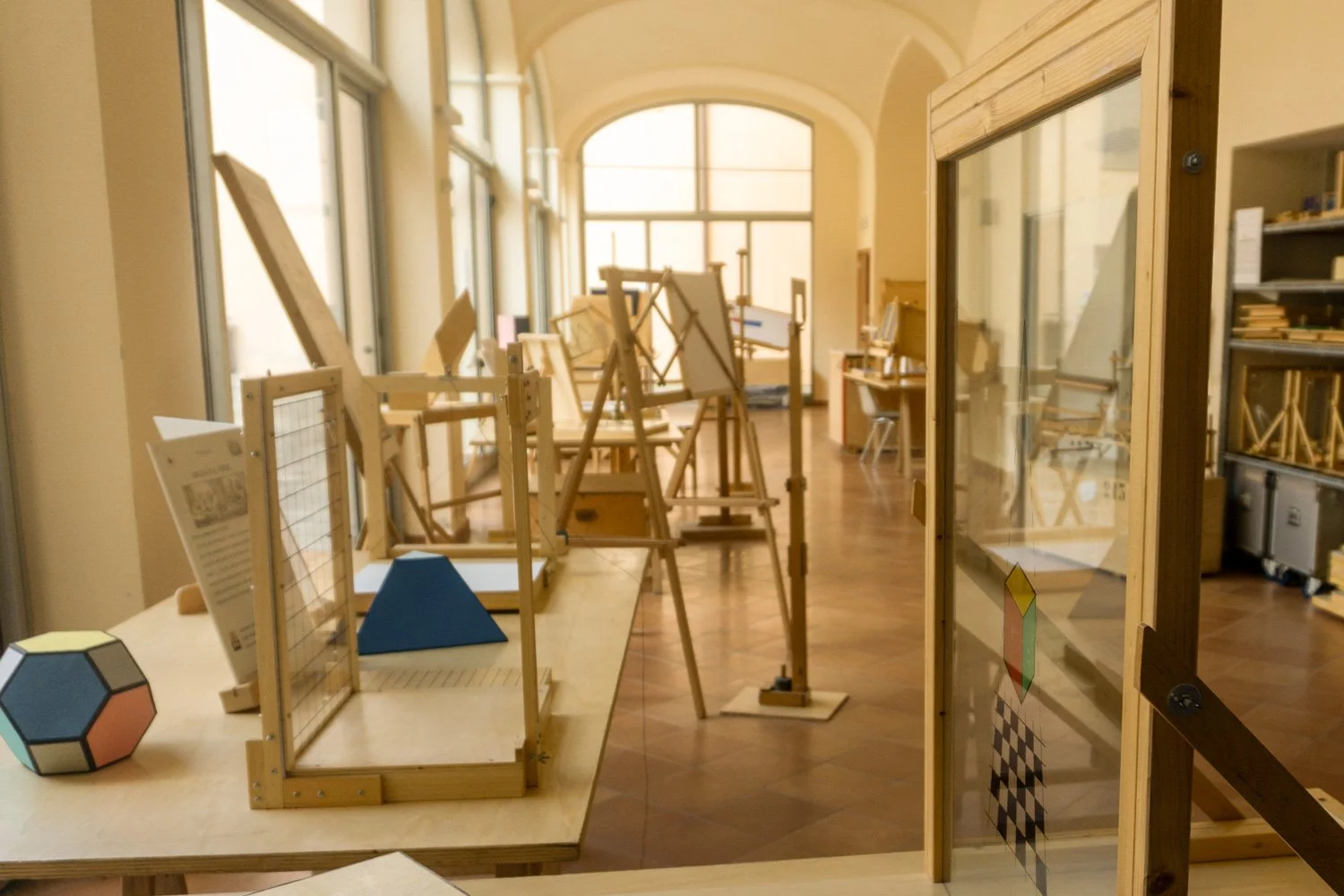
Research / Anamorphic Perspective
Anamorphic perspective is a visual and perceptual device that alters the appearance of an image according to a specific point of view. This research page outlines the historical foundations and contemporary applications of anamorphosis, with a particular focus on its role within public space, site-specific art, and large-scale visual interventions.
Anamorphosis as a Visual System
Anamorphosis is not a stylistic effect, but a structured visual system based on geometry, optics, and perception. By distorting an image according to precise spatial rules, the work becomes legible only from a determined viewing position, actively involving the observer in the act of seeing.
In public space, this mechanism transforms surfaces into dynamic perceptual fields. Floors, façades, corridors, and irregular architectures cease to be passive supports and become integral components of the image itself, activating movement and spatial awareness.
Historical Foundations
The principles of anamorphic perspective have deep historical roots in the study of vision and projection systems. Renaissance artists and theorists explored perspective not only as a representational tool, but as a means of investigating perception itself.
Leonardo da Vinci studied projection systems and optical devices as part of his broader research into vision and spatial representation. Albrecht Dürer formalized geometrical constructions for perspective in his treatise Underweysung der Messung, while Jean-François Niceron later systematized anamorphosis through optical and mathematical studies in the seventeenth century.
These historical investigations established a foundation in which image, geometry, and viewpoint are inseparable.
Play, Perception, and Participation
Play is a recurring element within Cuboliquido’s approach, functioning as a universal language capable of connecting different audiences. Visual surprise, distortion, and perceptual shifts encourage curiosity and engagement without requiring prior knowledge or specialized references.
Through these strategies, the work opens a dialogue with cultural memory, social values, and shared imagination. The experience is designed to be accessible, layered, and inclusive, allowing different levels of interpretation depending on age, background, and context.
Anamorphic Perspective in Contemporary Practice
In contemporary art, anamorphic perspective has shifted from a theoretical and cabinet-based practice to a spatial and experiential one. Advances in digital modeling, architectural surveying, and visualization tools have expanded its application beyond traditional surfaces.
Today, anamorphosis operates within complex environments, integrating architecture, circulation, and audience behavior. The illusion is no longer confined to representation, but becomes an experiential device that unfolds through movement and presence within real space.
From Theory to Site-Specific Application
Within Cuboliquido’s practice, anamorphic perspective functions as a bridge between historical knowledge and contemporary site-specific intervention. Digital tools are employed to translate theoretical projection systems into precise spatial constructions, adapted to the physical conditions of each environment.
Rather than emphasizing technical virtuosity, the focus lies on how anamorphosis can activate space, generate curiosity, and create shared perceptual experiences. The image emerges through interaction with the viewer, reinforcing the idea that perception is not fixed, but relational and situational.
Perception, Play, and Public Space
Anamorphic works often incorporate elements of play and visual surprise, inviting audiences to explore space actively. This playful dimension is not decorative, but functional: it lowers thresholds of access and encourages engagement across different ages and cultural backgrounds.
In public contexts, anamorphosis becomes a tool for questioning habitual ways of seeing, fostering moments of collective discovery, and transforming everyday environments into perceptual events.